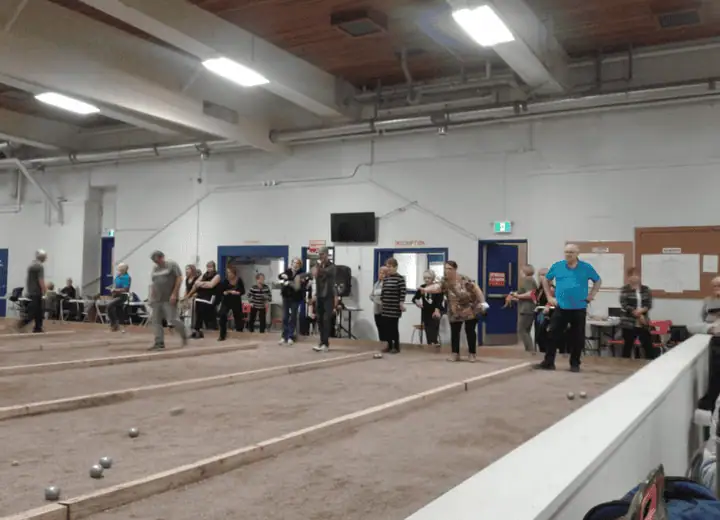
A good community pétanque event starts with one question: who is it for? A beginners’ open day, a club fundraiser and a competitive triples tournament need different formats, courts and budgets.
The steps below cover courts, formats, registration and promotion. Where a detail comes from the FPUSA tournament regulations, you can apply it to a casual event or skip it.
Decide what the event is for
Write one line that states the goal before you book anything. A goal like “bring 20 new players to the park” points toward short games, loaner boules and a coach on each court.
A fundraising goal changes the plan. You will want an entry fee, a longer format and prizes donated from local businesses.
Courts, space and equipment
How many courts you need
Every game takes one court, so each round needs half your team count in courts. Eight teams need four courts at once; sixteen teams need eight.
The FIPJP rules set a minimum lane of 12 x 3 m for most competitions and 15 x 4 m for national championships. Our court dimensions page shows how to fit lanes into a park or a gravel lot.
| Teams | Courts per round | Format that fits |
|---|---|---|
| 4 to 7 | 2 to 4 | Round robin |
| 8 to 11 | 4 to 6 | Fixed rounds, then finals |
| 12 or more | 6 or more | Swiss system, then single elimination |
What to bring
- Loaner boules in two or three weights for newcomers
- A pétanque measure for close points
- String and stakes to mark lane edges
- Throwing circles, rigid 50 cm ones or chalk
- Score sheets, a bracket board and pens
- Water, shade and a first-aid kit
If you run brackets on paper, print blank sheets from our scoresheet generator the night before.
Pick a format that fits the day
Team count decides the format more than anything else. FPUSA suggests a round robin under 8 teams, fixed rounds from 8 to 11 and a Swiss system from 12 teams up.
Round robin for small groups
Each team plays every other team once, which gives a fair ranking. Six teams means five rounds, enough to fill a day with untimed games.
Swiss system for 12 teams or more
After each round, teams meet opponents with the same record, so nobody goes home after one loss. Three qualifying games and a single-elimination stage fit into one day.
FPUSA uses that exact shape for one-day tournaments. Teams choose singles, doubles or triples at registration.
Time limits keep the schedule honest
An untimed game to 13 can last 20 minutes or two hours. FPUSA caps singles at 45 minutes, doubles at 60 and one-day triples at 60, each with one extra end once time runs out.
If the score is level after that end, teams play one last tie-break end. Announce the rule before the first game so nobody argues about it later.
Registration, check-in and umpires
Close registration at least a week before the event, the deadline FPUSA sets for sanctioned tournaments. A firm cut-off lets you draw brackets and buy prizes for the real headcount.
Open check-in 30 minutes before the first game and keep 20 minutes for announcements. Read out the time limit, the ruleset and how disputes get settled.
Do you need an umpire?
Casual events run fine with one experienced player per session who knows the rules and carries a measure. A sanctioned FPUSA tournament has a head umpire; an umpire must also be present for every semifinal and final.
FPUSA’s tournament director page has printable brackets, score sheets and report forms you can use for free.
Promote it where players already are
Start six weeks out with a post that gives the date, the format, the fee and a registration link. Repeat it every week with photos from earlier events.
- Your city’s parks and recreation calendar
- Libraries, senior centers and French cultural groups
- Bocce and lawn bowling clubs nearby
- The Pétanque Central tournament calendar
Nearby clubs can share the event with their members. Find them in the club directory.
Frequently asked questions
How many courts does a community pétanque event need?
Half the number of teams, since each game uses one court. Two courts cover a four-team social; eight teams need four.
How much should the entry fee be?
Add up permits, prizes, food and printing, then divide the total among the players you expect. An introduction day can stay free and ask for donations instead.
Do you need a certified umpire for a casual tournament?
No. An experienced player who knows the rules and carries a measure is enough.
What happens if it rains?
Light rain rarely stops a game on gravel, which drains fast. Announce a rain date in your first post in case of storms or lightning.
Which format suits beginners?
Short timed doubles with mixed pairs, one experienced player next to one newcomer. Rotate partners each round so everyone meets more people.