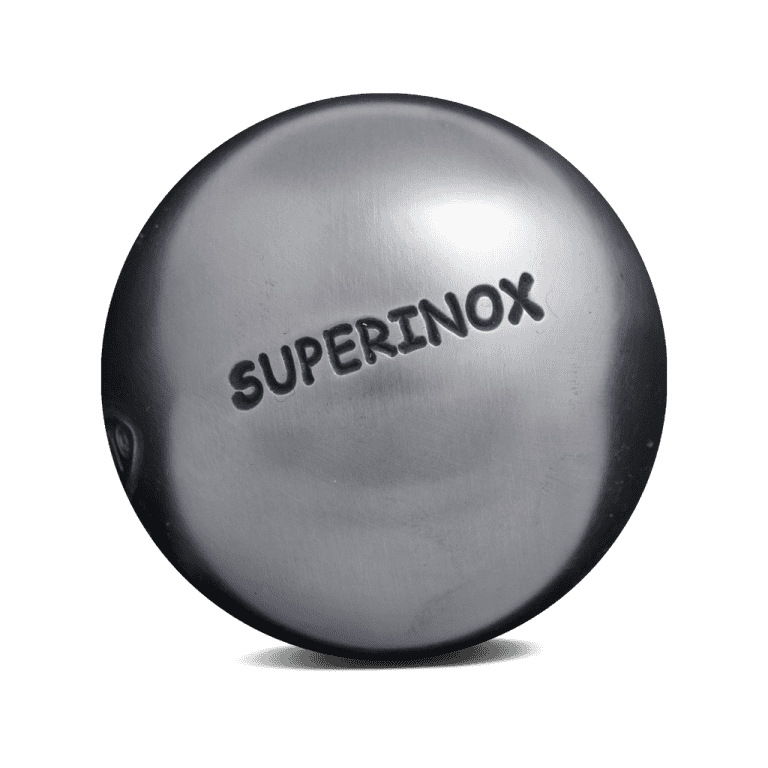
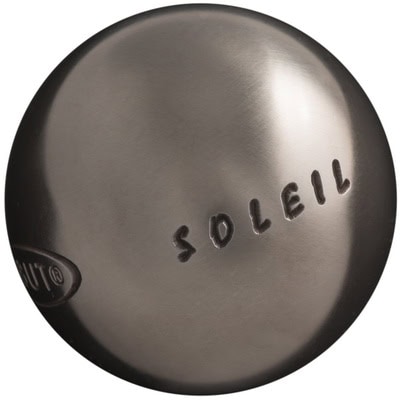
The numbers
Specifications
A floor, not a figure
Obut lists the Soleil at soft, over 110 kg/mm2, with no exact kg/mm2 or HRC value. The federation sets the floor for every approved boule at 35 HRC, which it equates to 110 kg/mm2.
Obut calls it the softest of stainless steel boules. The claim has no published number behind it, while La Boule Bleue gives 110 kg/mm2 for its Prestige Inox 110.
Two order forms, one published range
Obut’s specification for both versions reads 71 to 76 mm and 650 to 730 g, in 10 g steps. The striated order form matches that, with 54 pairings.
The smooth order form goes further. It also offers 77 mm at 730 and 740 g, 78 and 80 mm at 710 to 740 g and weights up to 750 g in 71, 72 and 76 mm.
Older claims of a 71 to 80 mm and 650 to 800 g range do not match either page.
A surface that marks
Obut rates the wear pronounced. It says the surface marks without losing the qualities of a soft boule.
Pétanque, once a month
New reviews, price changes, club spotlights and events across the US, Canada and Mexico.
Free. One click to leave.
Suitability
Who it is for
Suits you if
- You shoot on the iron and want a soft boule with low rebound
- You point with half lobs or roll the boule without spin
- Your home court is soft, flat or covered in gravel
- You would rather wipe stainless than oil carbon
- Your size falls inside 71 to 76 mm and 650 to 730 g
Look elsewhere if
- You play mostly on hard, stony ground, which Obut targets with the RCX
- You need a striated boule above 76 mm or 730 g
- You want a surface that stays clean for years
- You compare boules on an exact kg/mm2 number
- You need an uncommon size fast, with US stock limited to a few sizes
In the hand
How it plays
For the shooter
Obut calls the Soleil ideal for shooting on the iron and suitable for rolling shots from 4 m. It also says the boule lands well when shooting to the front.
On Obut’s hardness page, the softer the boule, the less it rebounds after a carreau. The glossary explains carreau and the other shooting terms.
For the pointer
Obut rates it suitable for roll pointing without spin and above all for half-lob pointing. It also says the boule stops quickly when pointed.
On different ground
Obut names soft, flat surfaces and above all gravel. It also promises low bounce on the ground.
Obut’s hardness page says its Impact Absorber+ boules absorb shocks particularly well on very hard ground. The RCX is the stainless model in that class.
Care and wear
Stainless does not mean no care. Obut asks for cleaning after each game and at least once a month when the set sits unused.
The maker also warns against leaving boules in a car trunk, where condensation can lead to oxidation. Store them indoors and dry.
The balance
Pros and cons
Pros
- Rated soft at over 110 kg/mm2, in solid stainless steel
- Stainless, so occasional care rather than regular oiling
- Three-year guarantee, the same on all Obut competition sets
- 54 size pairings from 650 g, smooth or striated
- Positioned for shooting on the iron and half-lob pointing
- In stock at a US dealer in a few sizes
Cons
- Pronounced wear rating from Obut, so the surface marks early
- No exact hardness figure, only a floor of 110 kg/mm2
- Striated version stops at 76 mm and 730 g
- Custom US orders cost $313 and take three to four weeks
- Costs 55 euros more than the carbon TON'R in France
The score
How this review scores it
Alternatives
How it compares
| Specification | Obut Soleil | Obut TON’R | Obut RCX | LBB Prestige Inox 110 |
|---|---|---|---|---|
| Material | Stainless steel | Carbon steel | Stainless steel | Stainless steel |
| Hardness | Soft, over 110 kg/mm2 | Soft, 110 kg/mm2 or over | Impact Absorber+, no figure | 110 kg/mm2, very soft |
| Diameters | 71 to 76 mm | 71 to 80 mm | 72 to 76 mm | 71 to 80 mm |
| Weights | 650 to 730 g | 650 to 800 g | 680 to 710 g | 650 to 800 g |
| Surface | Smooth or 1 striation | Smooth or 1 striation | Smooth | Smooth or striated |
| Warranty | 3 years | 3 years | 3 years | 5 years |
| Care | Occasional | Regular oiling | Occasional | Occasional |
| Maker price | 195 euros | 140 euros | 240 euros | 270 euros |
Soleil or TON’R
The TON’R is Obut’s soft carbon boule, rated 110 kg/mm2 or over and offered in 71 to 80 mm and 650 to 800 g. It lists at 140 euros against 195 for the Soleil.
The choice comes down to care and size. Obut says the TON’R needs regular oiling to avoid oxidation, but its published range reaches 80 mm and 800 g.
Soleil or RCX
The Obut RCX is Obut’s stainless Impact Absorber+ boule, at 240 euros in France and about $252 in the United States. Obut builds it for hard, pebbly ground, while the Soleil leans to soft ground and gravel.
Against a rated very soft stainless
The La Boule Bleue Prestige Inox 110 publishes 110 kg/mm2, sizes up to 80 mm and 800 g and a five-year warranty, made in Marseille. It costs 270 euros, 75 euros more than the Soleil.
It suits a shooter who wants a published hardness figure or a size beyond the Soleil’s range.
Before you order
Buying advice
Check your size first
The boule selector gives the diameter to look for. Anything outside 71 to 76 mm or 650 to 730 g rules out the striated Soleil.
Obut’s sizing advice puts the usual men’s diameters at 74 to 75 mm and the usual women’s at 72 to 73 mm. It adds that shooters tend to prefer a larger diameter for an easier release.
Smooth or striated
Obut’s striation advice says pointers tend to prefer striated boules for grip on difficult ground. Shooters tend to prefer smooth boules, which leave the hand more easily.
Where it is sold
A US dealer lists the smooth Soleil in stock at about $245 in October 2026, in a handful of sizes. Custom orders in either surface cost $313 with air freight from France and ship in three to four weeks.
Obut lists it at 195 euros in France and sells direct. Compare the landed cost with shipping and duty before ordering from Europe.
On orders placed with the maker, Obut offers classic or italic engraving for 15 euros and a stylized two-character mark for 19 euros. The equipment page covers the markings every competition boule must carry.
Keep the paperwork
Obut asks buyers to keep the warranty card on the box flap and the outer label for the three-year guarantee to apply.
Common questions
Questions about the Obut Soleil
How soft is the Obut Soleil?
Obut rates it soft at over 110 kg/mm2 and publishes no exact figure.
Every FIPJP approved boule must reach at least 35 HRC, which the federation equates to 110 kg/mm2.
Is the Soleil legal in sanctioned competition?
Obut states that the FIPJP has approved the set for competition.
The federation’s label list updated on 15 June 2026 has no OBUT SOLEIL line. It files OKARO SOLEIL and OKARO SOLEIL 110 under Boule Noire, a Saint-Bonnet-le-Château maker whose models Obut also sells.
What sizes does the Soleil come in?
Obut’s published range is 71 to 76 mm in 1 mm steps and 650 to 730 g in 10 g steps, which makes 54 pairings.
The smooth order form adds a few larger sizes, up to 80 mm and 750 g. The striated version stops at 76 mm and 730 g.
Does stainless mean no maintenance?
Less than carbon, but not none. Obut asks for cleaning after each game and at least once a month when the set is not used.
Condensation, for example in a car trunk, can still cause oxidation over time.
Why does the Soleil mark so quickly?
Obut gives it a pronounced wear rating, the same rating it gives the carbon TON’R. Its hardness page says plainly that a soft boule takes more marks from impacts.
The maker says the marking does not take away the qualities of a soft boule.
Should I buy the Soleil or the TON'R?
Both are soft Obut boules with a three-year guarantee. The TON’R is carbon steel at 140 euros, needs regular oiling and reaches 80 mm and 800 g.
The Soleil costs 55 euros more in France and needs only occasional care.
How this was verified
- Obut, SOLEIL 0-grade striated specification, sizes, kit and guarantee
- Obut, SOLEIL 1-grade striated specification and sizes
- Obut, commercial guarantee for each range
- FIPJP, homologation requirements for competition boules
- FIPJP, approved boule labels updated June 2026
- Obut, TON'R carbon steel specification