The numbers
Specifications
The seam pattern is the reason to buy this boule
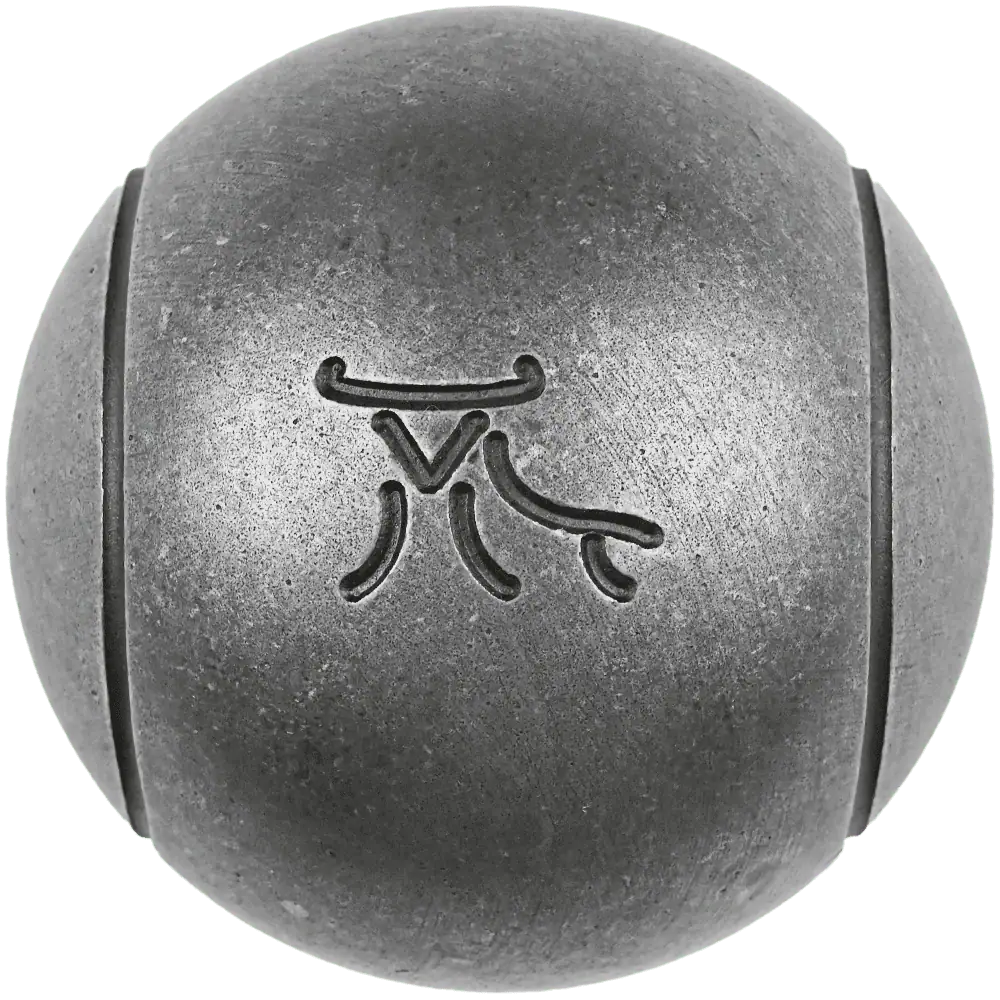
Most striated boules carry parallel rings cut around the circumference. Toro calls this pattern a tennis-ball design: curved seams that run across the boule along the same path the raised seams follow on a tennis ball.
The practical difference is orientation. Parallel rings give you grip across the rings and very little along them, so how the boule sits in your hand changes what you feel.
Curved seams cross every axis, so there is no smooth direction to find.
Toro sells it to middle players and pointers
The maker’s own description reads plus adapté pour les milieux et les pointeurs, better suited to middle players and pointers. That is the opposite of where a soft boule sits.
It matches the hardness. At 120 kg/mm2 the boule carries rather than stops, so the seams are there to help you release it, not to help you hit.
Pétanque, once a month
New reviews, price changes, club spotlights and events across the US, Canada and Mexico.
Free. One click to leave.
Suitability
Who it is for
Suits you if
- You point and shoot in roughly equal measure
- You play on damp municipal gravel more than dry clay
- You have never maintained a boule and do not intend to start
- You throw anywhere from 670 to 710 g
Look elsewhere if
- Shooting is the role you get picked for
- You want the softest legal boule you can get
- You would rather keep the $18 and take the plain version
- A visible surface pattern is not to your taste
In the hand
How it plays
Grip that does not depend on orientation
Pick up a boule with parallel rings and rotate it, and the feel changes when your fingers move from across the rings to along them. With curved seams there is no along.
The difference shows most on a wet court, where water sits in grooves that run parallel to your fingers. A curved seam crossing the contact patch keeps something biting.
Pointing
At 120 kg/mm2 it carries better than a soft boule and still settles rather than skidding on. MS Pétanque’s own advice calls semi-soft the best compromise for a middle player, which is the usual advice for a player who does a bit of everything.
On gravel the seams bite on release, which helps players who put backspin on a pointed boule. The pointing page covers the release itself.
Shooting
Competent rather than specialist. A semi-soft boule rebounds more than a soft one, so a carreau sur place is less likely than with a 110.
If shooting is most of your game, Toro’s own Carbon Smooth at 110 kg/mm2 does that job better and costs about $66 less.
Wear
Stainless removes the oiling routine entirely. Wipe it dry and put it away.
Toro calls the finish vibration: a matte surface worked into the steel through tumbling, not a coating. Play adds marks over time, which is cosmetic, and the grip comes from the seams rather than the finish.
The balance
Pros and cons
Pros
- Curved seam pattern grips the same way regardless of orientation
- Stainless steel, so no oiling and no rust
- Semi-soft at 120 kg/mm2 is the sensible band for a player who does both jobs
- Six diameters, 71 to 76 mm, and 670 to 720 g on the order form
- Sold in the United States at about $270, so no import from France
Cons
- $270 is Toro's dearest set and $66 above its own Carbon Smooth
- One-year warranty in Toro's terms, no longer than the carbon line
- The smooth stainless version is $18 cheaper if the pattern does not appeal
- 720 g comes in one diameter only, and Toro's spec text still says 680 to 700 g
The score
How this review scores it
Alternatives
How it compares
| Specification | Toro Petank Inox Striated | Toro Inox Smooth | Toro Carbon Smooth | MS STRX Inox |
|---|---|---|---|---|
| Material | Stainless steel | Stainless steel | Carbon steel | Chrome-nickel stainless |
| Hardness | 120 kg/mm2, semi-soft | 120 kg/mm2, semi-soft | 110 kg/mm2, soft | 115 kg/mm2, soft |
| Pattern | Curved seams | None | None | Striations |
| Diameters | 71 to 76 mm | 71 to 76 mm | 71 to 76 mm | 72 to 76 mm |
| Weights | 670 to 720 g | 650 to 720 g | 660 to 720 g | 680 to 720 g |
| Maintenance | None | None | Oiling required | None |
| Warranty | 1 year | 1 year | 1 year | 2 years |
| US price | About $270 | About $252 | About $204 | About $219 |
Toro’s own alternatives
The Inox Smooth is the same stainless at 120 kg/mm2 without the seams, at about $252. Toro calls it better suited to shooting, so the choice is about role and grip alike.
The Carbon Smooth is about $66 less and softer, and it is the better choice for a shooter who accepts oiling.
The MS STRX
The MS STRX is softer at 115 kg/mm2, forged with internal anti-rebound ribs and about $51 cheaper in the United States. MS gives it two years of warranty against Toro’s one.
It is the stronger buy unless you need 71 mm, since MS starts at 72 mm.
Before you order
Buying advice
Decide on the pattern before the price
The seams are the only real difference between this and the $252 smooth version. Handle both if a club member has either, because grip preference is not something to buy on description.
Players who wear gloves or play in consistently dry heat get less from the pattern than players on damp municipal gravel.
Weight first, every time
Toro’s order form lists 670 to 720 g in 10 g steps, but 720 g comes only in 73 mm, and the spec text on the same page still says 680 to 700 g. Confirm an unusual size before paying.
MS Pétanque’s buying advice puts shooters at 680 to 700 g, middle players at 680 to 720 g and pointers at 710 to 720 g. The boule selector works through the same question.
Standard sizes against a direct order
The going rate of about $270 covers the common sizes that reach the United States. Anything else means ordering from Toro in France, which ships worldwide.
Toro’s site shows North American buyers about 166 euros a set without French VAT, before shipping. Outside the European Union the buyer is the importer and pays any duties on arrival.
Marking rules still apply
The federation’s rules forbid altering the maker’s mark, the label or the three-digit weight after sale. Your own initials or any symbol are permitted on top of the required marks.
Toro engraves up to three characters for 11 euros and up to fourteen for 17 euros when you order. The equipment page sets out what a competition boule has to carry.
Common questions
Questions about the Toro Petank Inox Striated
What is the tennis-ball pattern?
Curved seams that run across the boule following a figure-eight path, rather than the parallel rings most striated boules use. The geometry matches the raised seams on a tennis ball.
The point is that no orientation is smooth, so grip does not change when the boule turns in your hand.
Is stainless worth the extra over carbon?
It costs $66 more here and removes the oiling routine permanently. That trade is worth it if you are not disciplined about maintenance, and wasted money if you are.
A neglected carbon boule rusts. A neglected stainless boule gets dirty.
Semi-soft or soft?
At 120 kg/mm2 this is semi-soft, which favors all-round play. Toro’s carbon at 110 is soft and favors shooting.
If you shoot most of the time, the softer boule is the better tool and the cheaper one.
How long is the warranty?
One year. Toro’s sales terms give one year against defects on its competition boules, stainless and carbon alike, and a claim needs the invoice.
If you buy in the United States, ask the seller for its own terms in writing.
Will the finish wear off?
There is no coating to wear off. Toro calls the finish vibration, a matte surface worked into the stainless through tumbling, and play adds marks over time.
The seams are cut into the boule, so the grip that justifies the price stays with it.